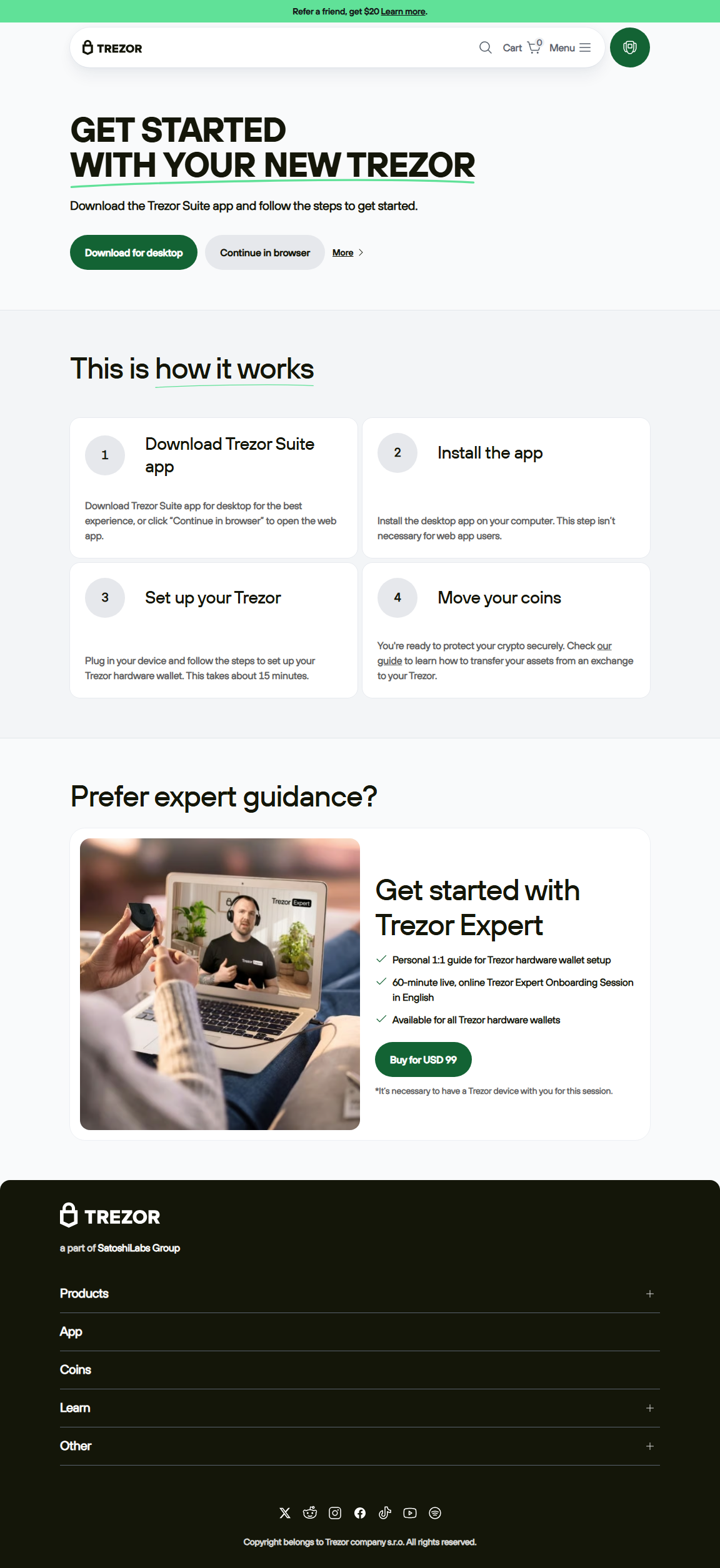
Trezor.io/Start is the official place to begin setting up a Trezor hardware wallet, but its purpose goes beyond simple configuration. It introduces users to a model of crypto ownership built on transparency, independence, and informed decision-making. Instead of relying on centralized platforms, Trezor empowers users to hold and protect their assets on their own terms.
Many crypto tools prioritize speed and ease, often at the cost of understanding. Trezor takes a different path. Trezor.io/Start encourages users to learn what protects their assets and why each security step matters. This knowledge-first approach helps users avoid common mistakes and builds confidence in self-custody.
Security becomes something you practice, not something you assume.
Trezor’s foundation is built on open-source technology. Its firmware and software can be publicly reviewed, helping identify weaknesses before they become risks. Trezor.io/Start introduces this concept early, explaining how transparency replaces blind trust with verifiable security.
This openness strengthens reliability over time.
Before beginning setup, Trezor.io/Start explains how to confirm that your device is new and uncompromised. Trezor wallets are never shipped with preset PINs or recovery seeds. This ensures that no one else has access to your wallet credentials.
Security begins with eliminating assumptions and unnecessary trust.
Trezor.io/Start guides users to install Trezor Suite, the official interface for managing their wallet. Trezor Suite allows users to send and receive crypto, manage multiple assets, and verify transactions while keeping private keys safely stored on the hardware device.
Every sensitive action requires physical confirmation, protecting users from remote threats.
During setup, the Trezor device generates a recovery seed. Trezor.io/Start reframes this moment as a transfer of control. Whoever holds the recovery seed holds the assets. This step is treated with seriousness, encouraging users to think about long-term storage, resilience, and inheritance.
The seed represents responsibility as much as security.
Rather than focusing on rare worst-case scenarios, Trezor.io/Start introduces realistic threat awareness. Users learn about phishing, compromised computers, and social engineering—risks most likely to affect everyday users. This practical approach helps users make smarter decisions without unnecessary fear.
Understanding threats leads to stronger protection.
Trezor wallets support a broad range of cryptocurrencies, including Bitcoin, Ethereum, and many altcoins. Through Trezor Suite, users can manage diverse portfolios while maintaining strong isolation of private keys. Trezor.io/Start highlights how this balance allows growth without sacrificing control.
Your wallet evolves as your assets do.
Trezor does not require user accounts or personal data. Trezor.io/Start emphasizes that privacy is built into the system from the start. Transactions are verified locally, and no activity tracking is imposed on users.
This design aligns with the decentralized values that inspired cryptocurrency.
Trezor.io/Start is designed to help users think beyond the initial setup. By explaining concepts rather than hiding them, it encourages habits that support long-term independence. Users learn not just how to use a wallet, but how to rely on themselves instead of intermediaries.
Self-custody becomes sustainable, not intimidating.
Trezor.io/Start marks the beginning of a thoughtful approach to crypto ownership. By choosing Trezor, users choose transparency, education, and autonomy. With open-source foundations and a security-first mindset, Trezor offers a principled way to protect digital assets in an evolving crypto landscape